Superior Heat Transfer
Evaporative cooling technology achieves higher efficiency than dry cooling alternatives.
Corrosion-Resistant Build
Constructed with FRP and galvanized steel to withstand harsh industrial environments.
Flexible Configurations
Available in induced/natural draft and counterflow/crossflow designs for any scale.
Place of Origin:China
Brand Name:Water Cooling Tower
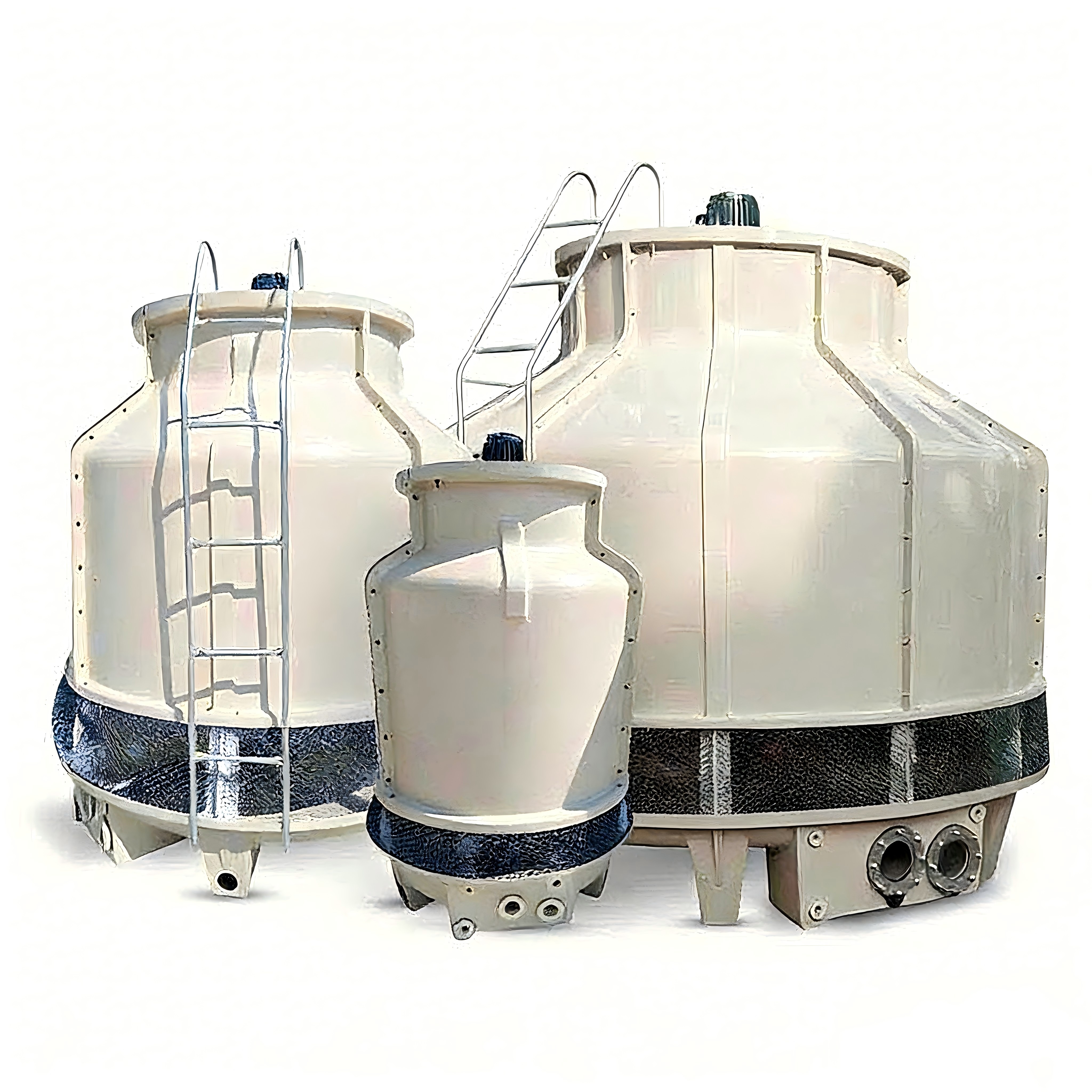
A water cooling tower, also known as an evaporative cooling tower, is a critical heat rejection device designed to dissipate excess heat from industrial processes and commercial HVAC systems. Operating on the principle of evaporative cooling, our towers circulate hot water through the unit, where it comes into direct contact with air. As a small portion of the water evaporates, it absorbs heat, significantly lowering the temperature of the remaining water. This cooled water is then recirculated back into your system, ensuring optimal operational efficiency .
Our industrial water cooling towers are engineered for durability and performance. Constructed with corrosion-resistant materials such as FRP (Fiber-Reinforced Plastic) and hot-dip galvanized steel, they are built to withstand harsh environments, whether in petrochemical plants or power generation facilities . Unlike dry cooling alternatives, our wet cooling solutions provide superior heat transfer capabilities, achieving cooling efficiencies that are essential for large-scale thermal management .
We offer a comprehensive range of configurations, including induced draft, forced draft, and natural draft designs, available in both counterflow and crossflow arrangements . Whether you require a compact unit for a manufacturing facility or a field-erected tower for a thermal power plant, our water cooling towers deliver consistent, reliable performance.
Our water cooling towers serve a diverse range of high-demand industries :
Power Generation: Essential for thermal and nuclear power plants, these towers manage waste heat from turbines and generators, condensing steam back into water to maintain cycle efficiency.
Chemical & Petrochemical: In oil refineries and chemical processing plants, precise temperature control is critical for safety and yield. Our towers cool water used in distillation, cracking, and other exothermic reactions.
HVAC & Commercial Cooling: Large commercial complexes, airports, hospitals, and data centers rely on cooling towers for their central air conditioning systems to dissipute heat from chillers.
Manufacturing: From food and beverage processing to pharmaceutical production and heavy equipment manufacturing, our cooling systems regulate temperatures for machinery, molds, and process cooling.
Metalworking: Specifically used for cooling induction furnaces, die-casting machines, and welding equipment to prevent overheating and ensure product quality .
Choosing our water cooling tower means investing in efficiency, longevity, and peace of mind :
Superior Thermal Efficiency: Utilizing evaporative cooling, our towers achieve significantly lower water temperatures compared to air-cooled systems, reducing energy consumption for chillers and compressors.
Low Maintenance & Operational Cost: Designed with easy-access components, drift eliminators to minimize water loss, and energy-efficient axial fans, we help reduce your total cost of ownership.
Environmentally Conscious: Optimized water management systems reduce blowdown and water consumption, while low-noise fan options help meet stringent community noise regulations .
Q1: How does a water cooling tower work?
A: It works through evaporative cooling. Hot water from your process is sprayed over a "fill" (heat transfer media) inside the tower. Air is drawn or pushed through the tower by fans. As the water and air meet, a small portion of the water evaporates. This evaporation removes heat from the remaining water, which then collects in a basin at the bottom and is sent back to cool your equipment .
Q2: How much water does a cooling tower lose?
A: The primary water loss is through evaporation, which is the actual cooling mechanism. A very minimal amount is also lost as "drift" (tiny droplets carried out by the air) and "blowdown" (water discharged to control mineral buildup). The evaporation rate is directly tied to your heat load and ambient conditions .
Q3: What maintenance is required?
A: Regular maintenance is key to efficiency. This includes checking and cleaning the basin, inspecting nozzles for clogs, ensuring fans and motors are lubricated, and monitoring water quality to prevent scale and biological growth (like Legionella). We recommend a professional inspection at least annually .
Q4: What is the difference between crossflow and counterflow?
A: In a crossflow tower, air flows horizontally across the falling water. In a counterflow tower, air flows vertically upward, directly opposite the water flow. Counterflow designs are often more space-efficient, while crossflow designs can offer easier maintenance and lower pump head .

Copyright © Yingkou Minzheng Plastic Machinery Co., Ltd. All rights reserved. - Privacy policy
 EN